Most buyers pick a Teflon hose for its chemical resistance, then they check the pressure rating, match the fittings and move on. Vacuum rarely makes it onto that checklist. Then a pump starts pulling suction, or a tank cools after a hot wash, and the hose meets a load nobody sized it for. Outside air now presses inward on a thin plastic liner, and that liner can fold before anyone notices a drop in the flow.
A collapsed liner is a quiet failure. The braid on the outside can look perfect while the tube inside has creased, and a crease in PTFE often stays as a weak point. Send aggressive chemicals, including weak acids, chlorine, acetyl chloride, ammonium nitrate, oleum, and molten sulphur through that Teflon hose later, and the crease is where trouble usually begins. The bore you choose, along with size, heat and routing, decides whether it ever happens.
Why Vacuum Is Harder on a Teflon Hose Than Pressure
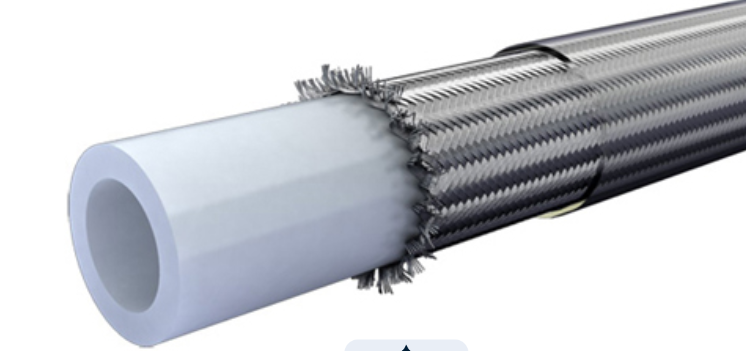
Under pressure, the liner pushes outward, and the braid takes the load. JRE’s hoses have a PTFE tube with an external SS 304 braid, and that braid works well while the force acts outward.
Vacuum turns the force around. The air outside pushes in, and the braid has nothing to hold back. PTFE hose is relatively thin-walled and therefore subject to vacuum collapse if not properly specified and protected. On a single-braided smooth-bore hose, the loose metal braid is of limited value in a vacuum application, especially as temperature increases.
Engineers call the wall’s resistance to being squeezed flat “hoop strength”. The term sounds technical, but it only means how well a round tube stays round when something presses on it from outside.
Four Factors That Set the Vacuum Limit of a PTFE Hose
The primary factors that affect hose performance under vacuum are hose size and construction, temperature and bend radius.
- Size: Smaller IDs, thicker walls, external reinforcement such as wire wrap or covers, and bonding the hose layers together all add hoop strength.
- Temperature: As a hose’s temperature increases, hoop strength typically decreases because the material softens.
- Bend radius: Near its bend limit, the hose profile will go from round to oval, and an oval tube gives way more easily.
The last point catches people out more than the others. A hose that holds vacuum lying straight on a test bench may behave quite differently once it curls behind a reactor. One manufacturer states plainly that its vacuum ratings are based on testing done on straight assemblies. Bent assemblies may have reduced vacuum resistance.
How a Corrugated Bore Teflon Hose Holds Its Shape
A corrugated bore has a wall formed into a run of ridges and grooves. Each ridge acts as a small stiffening ring along the length. That ribbed profile helps the wall keep its round form under inward load, perhaps more than many buyers expect.
Bending is where the gap really shows. Look at JRE’s own figures. The 1/2″ smooth bore hose, JT-12, has a minimum bend radius of 5.2 inches. The 1/2″ corrugated version, JRC-12, bends to just 1 inch. That is more than five times tighter.
Here is why it matters for vacuum. Route both hoses around a 6-inch bend. The smooth-bore hose sits near its limit, where the profile starts turning oval. The corrugated hose is nowhere near its limit, so it stays round and keeps its hoop strength.
Size plays a part too. JRE’s published corrugated range goes up to JTC-100 | 4 inches, while the smooth bore table stops at 1-1/4 inches. Wider suction lines point towards corrugated almost by default.
Where a Smooth Bore Teflon Hose Still Makes Sense
It would be wrong to say corrugated always wins. Small smooth bore sizes carry far higher pressure, with JT-5 | 3/16 | .234 | 3000 PSI at the bottom of the range. The smallest corrugated sizes are rated at 1000 PSI. A narrow bore also resists collapse better by nature.
See Also: What to Look for When Shopping…
So a short, straight, small-bore line at room temperature may handle mild suction without any fuss. Some engineers also like a smooth inner wall because the product has no grooves to sit in. Still, once a line has to bend tightly or run hot, the case for smooth bore gets weaker. Not always, but often enough to make you pause.
Heat Changes Every Teflon Hose Vacuum Rating
JRE lists a range of -73 °C to 260 °C for both types. That figure tells you what temperatures the hose tolerates. It does not promise full vacuum at 260 °C.
Manufacturers who publish vacuum data say the same thing in different ways. One notes that higher temps or bending applications will derate vacuum values. Another rates a convoluted PTFE design as vacuum-resistant to -0.9 bar up to 150C (302F), showing how much a temperature limit shapes the vacuum number.
To Summarize
Corrugated bores give you room to bend and a profile that tends to stay round, which is usually what a vacuum line needs most. Smooth bores still suit short, straight, high-pressure runs. To compare both styles by size, bend radius and working pressure, visit JRE’s PTFE flexible Teflon hoses page.